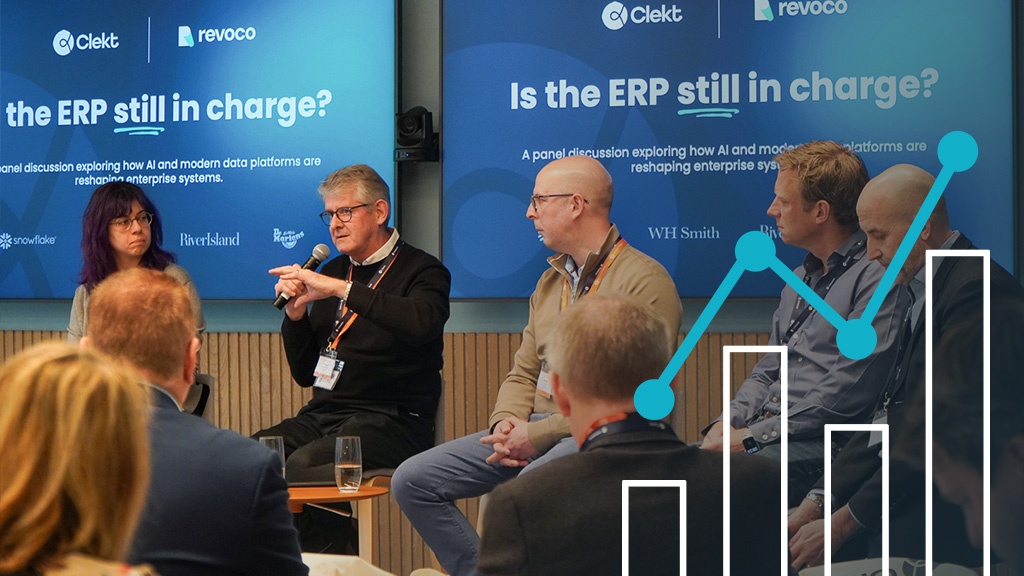

At our recent breakfast event with Clekt at Snowflake’s London HQ, we brought together a panel of senior retail technology leaders to explore a question that is becoming harder to ignore:
Is ERP still the brain of the business, or has it become just another execution system?
Joining the discussion were:
- Simon Pakenham-Walsh, CIO at River Island
- Peter Swann, Group Operating Director at WHSmith
- Paul Winsor, Head of Retail EMEA at Snowflake
- Sezin Cagil, Head of Unified Commerce Technology at Dr. Martens
- Andy Tudor, CEO at Clekt
The session was chaired by Iain Blair, Founder of Revoco.
TL;DR
The verdict? ERP isn't dead, but it's no longer in charge. Intelligence is migrating to data platforms and AI layers, and the organisations winning are those rethinking culture, governance, and ownership of data alongside the technology itself.
1. The ERP has a new job description
The panel was unambiguous on one point: ERP isn't going away, but it's no longer in charge.
There was broad agreement that many retail organisations are actively simplifying their ERP footprints, stripping out customisations and reducing these systems to their most stable, defensible core.
The goal isn't to sideline the ERP, but to allow it the freedom to focus on its strengths. By reducing complexity, businesses can integrate more freely with specialised, agile services better suited to the pace of modern retail.
ERP remains the trusted source of record for core data definitions and process control, but the expectation that it should also serve as the system of insight and agility has largely been abandoned.
2. Excel is still where decisions actually happen
Perhaps the most telling observation of the morning was one that will be familiar to almost every senior technology leader: a significant proportion of business decisions are still being made in spreadsheets.
Despite years of investment in ERP, BI tooling and now AI, Excel remains the default decision-making environment for many teams.
The reasons are partly cultural, as people trust what they know, but they also reflect genuine limitations in the responsiveness and flexibility of enterprise systems. When AI-generated answers differ from the numbers a team has been working with in a spreadsheet, it doesn't automatically lead to a conversation about data quality. It leads to a loss of trust in the AI, and a return to the familiar.
3. The intelligence layer is moving to the data platform
If ERP is retreating to its core, something has to fill the space it leaves behind.
The panel pointed firmly to AI and, more specifically, to intelligent agents built on modern data platforms, as the emerging intelligence layer for enterprise decision-making.
These agents enable business users to ask complex questions in natural language, receiving answers drawn from both internal and external data sources in a secure, governed environment. A category manager querying competitor pricing and having an answer before they have finished their morning coffee is not a hypothetical. It is already operational in a number of organisations.
The pace of development over the past twelve months alone has been remarkable, and AI is no longer a future consideration for these businesses. It is an active and accelerating presence.
Paul Winsor, Head of Retail across EMEA for Snowflake rightly commented that a category manager shouldn’t have to wait until Monday morning to find out whether a competitor has undercut their pricing overnight. With the right data foundations and intelligent agents in place, that question can be answered before the morning coffee has been finished.
4. Trust is still the bottleneck
The panel was enthusiastic about the direction of travel, but also realistic about what still gets in the way. Across the discussion, one issue kept surfacing: trust.
The difficulty of building confidence in AI-generated answers came up repeatedly, particularly when different tools or prompts produce slightly different outputs. When that happens, people retreat to familiar territory, spreadsheets, manual workarounds, and slower decision-making.
The issue is not whether AI can produce answers. It is whether the business trusts those answers enough to act on them. Until that confidence is established, even the most capable AI implementation will struggle to change behaviour at scale.
5. The near-term opportunity is augmentation, not automation
The panel did not suggest that AI is about to run retail operations end to end. One of the more grounded takeaways from the event was that the most valuable near-term use cases are AI-assisted decision-making, not full automation.
Demand forecasting was held up as the clearest example. Done well, AI can integrate multiple data sources and weight business priorities far more effectively than traditional opinion-led planning. But the goal is not to remove people from the process. It is to improve the quality and speed of the insight they work from.
The same logic applies across pricing, supply chain, and broader commercial planning. For most organisations, the practical next step is not handing over control. It is using AI to support better decisions while humans remain accountable for the outcome.
6. Culture and governance are doing the heavy lifting
Across the panel, there was consistent agreement that the technology itself is rarely the limiting factor in AI adoption. The harder problems are governance, sponsorship, and culture.
For intelligent agents to deliver value, they need to be owned by business users rather than IT departments. Foundational questions around data ownership, how definitions are agreed, which queries are considered reliable, and where accountability sits all need to be resolved before AI can deliver at scale. Verified queries, answers checked and approved by relevant business owners, are key to building the institutional confidence that makes AI outputs actionable rather than theoretical.
Senior leaders who mandate exploration, create psychological safety around experimentation, and hold teams accountable for engaging with new tools are the difference makers. The solution is not to force adoption, but to build trust incrementally through communication, transparency, and demonstrated value.
7. The business user is taking the wheel
Looking ahead, the panel converged on a clear directional view: data ownership and AI capability will shift progressively towards business users, away from centralised IT functions.
Commercial teams will increasingly own AI agents and define the questions they answer. The most valuable future hires will not necessarily be those who can build systems, but those who can ask the right questions of them.
For technology leaders, that means rethinking what their function is actually for, less about building every solution directly, and more about creating the foundations, setting guardrails, and making it safe for the business to explore and adopt AI responsibly.
Key takeaways
- ERP is not dead, but it is narrowing. Its future role is as a stable, auditable core, not the system of intelligence for the business.
- Excel still dominates decision-making in many organisations, reflecting both the rigidity of ERP and a cultural trust deficit in newer tools.
- AI is the emerging intelligence layer, with intelligent agents on modern data platforms already delivering measurable value in speed and accuracy.
- Trust is the primary bottleneck, not technology. Organisations need to resolve foundational questions around data ownership, definitions, and accountability before AI can deliver at scale.
- The near-term opportunity is augmentation, not automation. AI-assisted decision-making in forecasting, pricing, and supply chain is where most organisations should be focused.
- Data governance, business sponsorship, and cultural change matter more than the technology in determining whether AI delivers value.
- Technology teams need to evolve. The shift is from building solutions to enabling the business to explore, experiment, and own AI responsibly.
- The economics are more accessible than many expect, with consumption-based pricing and rapid deployment models significantly reducing implementation risk.
- The future belongs to commercially fluent data users, not just technical specialists.
Want to hear about future events?
We’ll be hosting more senior-level discussions with technology, data and transformation leaders over the coming months.
If you’d like to hear about future Revoco events, sign up here:
Revoco is a specialist technology recruitment business working with senior leaders across data, AI, enterprise applications, and technology transformation. Find out more about our services here.